C-135C Speckle Trout
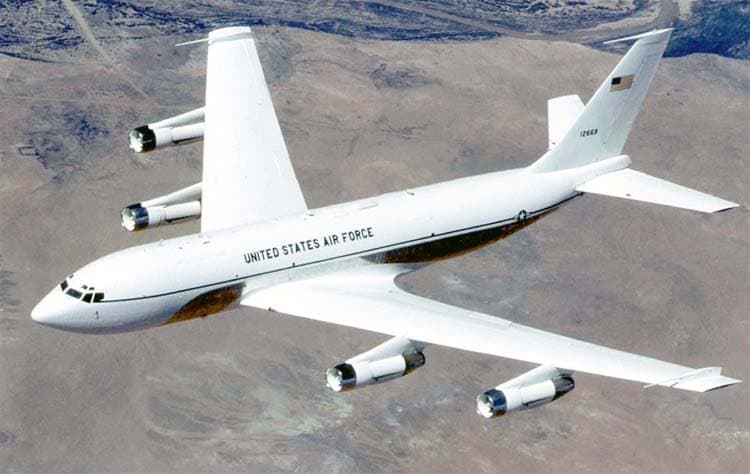
Perhaps the most interesting variant of the Boeing C-135 was the C-135C Speckled Trout, initially ordered as a VIP transport. However, as part of a program to test new control and communication systems, it was equipped with relevant communication apparatus and data exchange systems.
Origins and Purpose
The aircraft (serial number 61-2669) was reconfigured in 1974 under the Speckled Trout program. It was operated by the 412th Flight Test Squadron (412 FLTS) of the USAF Materiel Command (AFMC), based at Edwards Air Force Base.
Flying Laboratory and Legacy
The C-135C also served as a flying laboratory for developing space navigation systems, wireless communication systems, and other advanced technologies. It was decommissioned on January 13, 2006.
Its functions were transferred from 2008 to a modified KC-135R Speckled Trout, equipped with more advanced communication devices, thus continuing its legacy of innovation.
Technical Specifications
| Modification | C-135С |
| Wingspan, m | 39.88 |
| Aircraft length, m | 41.53 |
| Aircraft height, m | 12.70 |
| Wing area, m2 | 226.03 |
| Empty weight | 46403 |
| Maximum takeoff weight | 135626 |
| Internal fuel, kg | 86047 |
| Engine type | 4 Turbofan Pratt Whitney TF33-P-9 |
| Thrust, kN | 4 x 80.07 |
| Maximum speed, km/h | 909 |
| Cruising speed, km/h | 780 |
| Practical range, km | 9100 |
| Operational range, km | 4308 |
| Service ceiling, m | 12375 |
| Crew, crew members | 4-5 |
Image and diagram gallery of the C-135C Speckle Trout
 C-135C Speckle Trout |
 C-135C Speckle Trout |
 C-135C Speckle Trout |
 C-135C Speckle Trout |
 C-135C Speckle Trout |
ArchivoAéreo Editorial Team
A group of aviation researchers and enthusiasts dedicated to documenting and preserving global aeronautical history. All articles are reviewed to ensure historical accuracy.
Sources & Accuracy
The information presented in this technical sheet has been compiled from declassified flight manuals, historical archives, and specialized literature. While we strive for maximum accuracy, some performance data may vary depending on the specific variant or operational conditions.